

For many businesses, a CRM is just a database.
A place to store contacts.
Track deals.
Log notes.
And when it doesn’t deliver the clarity or growth they expected, the conclusion is often the same:
“We need a better CRM.”
In reality, the problem usually isn’t the software.
It’s the absence of a business system for that software to support.
Why CRM Projects So Often Disappoint
CRM platforms are powerful.
They’re also frequently underwhelming in practice.
That’s because most CRM implementations focus on:
- Features instead of workflows
- Configuration instead of outcomes
- Data capture instead of decision-making
Without a clear operating model, a CRM becomes little more than a digital filing cabinet – expensive, underused, and disconnected from day-to-day reality.
Related Post: What Digital Transformation Actually Means for Growing Businesses
A CRM Should Reflect How the Business Actually Operates
A CRM is meant to sit at the centre of your business – not off to the side.
When designed properly, it should reflect:
- How leads enter the business
- How opportunities are qualified
- How handovers occur between teams
- How follow-up is triggered
- How customers are supported over time
If the CRM doesn’t mirror real workflows, teams either ignore it or work around it.
Neither outcome delivers value.
One Source of Truth Changes Everything
One of the most important roles of a CRM is to act as a single source of truth.
Without that:
- Sales, marketing, and operations see different versions of reality
- Reporting becomes unreliable
- Decisions are made on partial information
- Accountability becomes blurred
A system-first CRM brings alignment by ensuring everyone is working from the same data, governed by the same rules.
Clarity replaces conversation.
Visibility replaces guesswork.
Related Post: From Disconnected Tools to Unified Growth Engine

CRM as an Operating System, Not a Tool
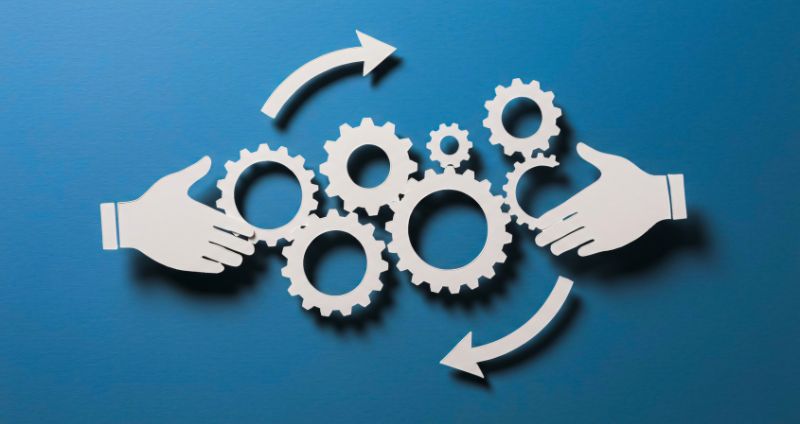
The most effective CRMs function less like software and more like an operating system for the business.
That means they:
- Orchestrate workflows across teams
- Trigger automation at the right moments
- Surface insights instead of raw data
- Support consistency without micromanagement
In this context, the CRM isn’t “another system” – it’s the system everything else connects to.
Why Most Businesses Only Use a Fraction of Their CRM
It’s common for businesses to use 10–20% of their CRM’s potential.
Not because they lack ambition – but because:
- The system was never designed holistically
- Teams weren’t aligned on usage
- Automation was added before clarity
- Ownership was unclear
Full utilisation doesn’t come from using more features.
It comes from using the right features intentionally.
Related Post: The Difference Between Funnels and Revenue Systems
CRM Design Is a Leadership Decision
CRM success is rarely determined by the platform chosen.
It’s determined by:
- How clearly leadership defines processes
- Whether the CRM is embedded into daily operations
- How seriously data integrity is treated
- Whether the system is reviewed and refined over time
When leadership owns the system, adoption follows naturally.
This is also where many growing businesses benefit from strategic, fractional guidance – aligning systems with business goals before scaling execution.
The
Bottom
Line
A CRM isn’t something you “set up.”
It’s something you design, govern, and evolve.
When treated as a business system rather than a piece of software, a CRM becomes one of the most powerful growth assets a company can have.
Check Out CRM Here